
Exclusive Analysis for Global Agricultural Review
In these first uncertain weeks of 2026, as geopolitical tensions escalate and AI breakthroughs outpace ethical frameworks, humanity’s most elemental challenge remains unchanged: feeding a fractured world.
While headlines fixate on trillion-dollar AI valuations and nuclear brinkmanship, a quieter revolution is unfolding across 12% of Earth’s habitable land—our farms.
Drones and artificial intelligence are no longer futuristic concepts; they are actively rewriting agriculture’s DNA.
This comprehensive analysis examines what this transformation truly means for the hands that feed us—from Iowa mega-farms to subsistence plots in Malawi—and why getting it right may determine whether technology becomes agriculture’s salvation or its deepest vulnerability.
I. The Harvest of Progress: Tangible Gains Reshaping Farms Today
Early adopters are already reaping benefits that redefine efficiency:
- Precision That Pays:
John Deere’s fully autonomous See & Spray™ Ultimate system (deployed on 8,000+ U.S. farms in Q4 2025) uses computer vision to target-spray weeds, slashing chemical use by 60% while boosting yields 8% (2025 grower data).In India, startups like Ninjacart deploy drone swarms to monitor 50,000+ smallholder chili farms, reducing pest losses by 35% through AI-driven early alerts.
- Water Crisis Mitigation:
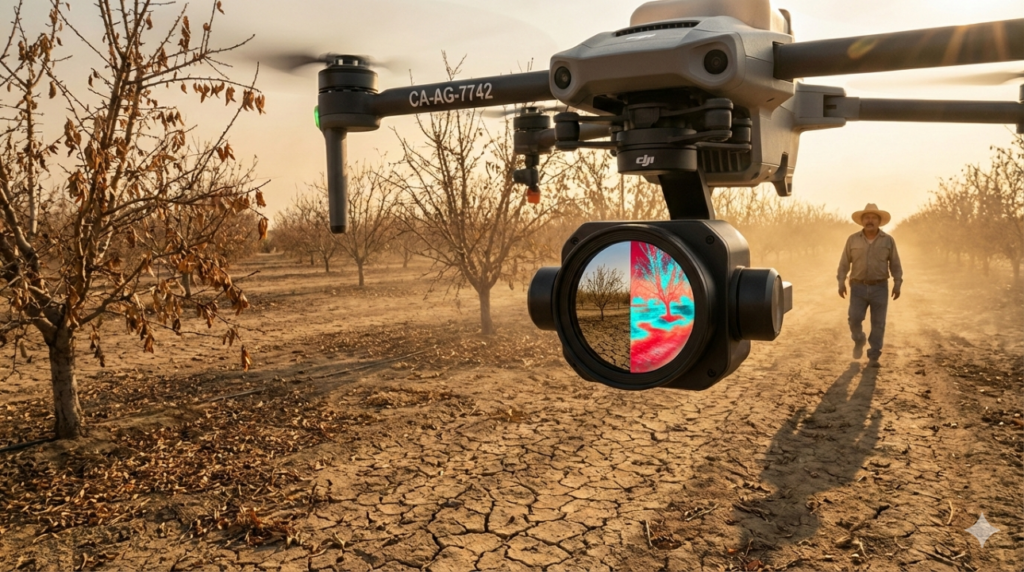
Amid California’s fifth consecutive drought year, AI irrigation platforms like CropX integrate drone thermal maps with soil moisture sensors, cutting water use by 30% while maintaining yields.
Similar systems in Kenya’s Rift Valley are now subsidized by World Bank climate resilience grants. Labor Revolution:
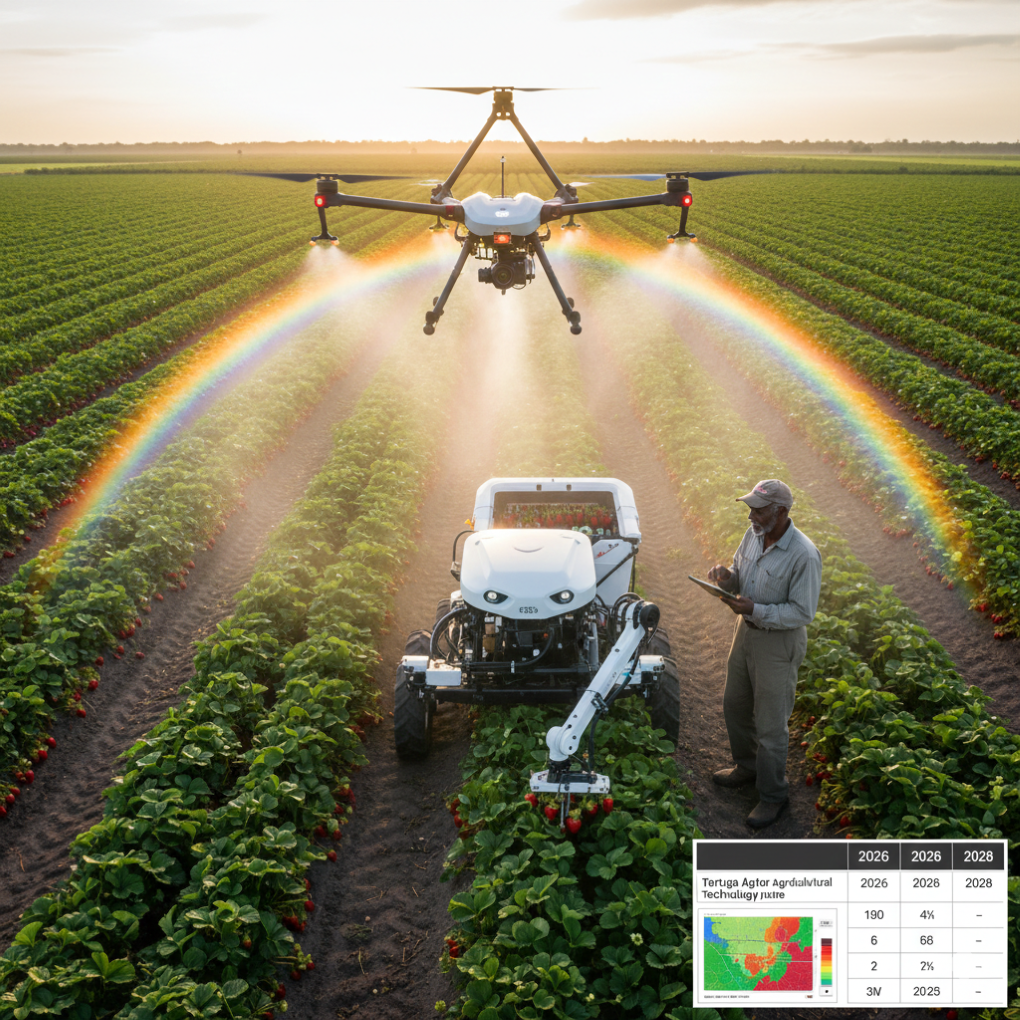
With U.S. farm labor shortages at 20-year highs (USDA, Jan 2026), robotic harvesters from Tortuga AgTech are picking 25,000+ strawberries daily in Florida fields.
For aging farmers like 68-year-old Nebraska corn grower Earl Henderson, drone scouting replaced 14-hour field walks: “I see crop stress before it’s visible to my eyes. This isn’t tech—it’s survival.”
II. The Shadow in the Soil: Documented Risks Demanding Urgent Action
The technology’s darker dimensions are no longer theoretical:
- The Data Grab:
Investigations by Civil Eats (January 15, 2026) reveal that 7 of 10 major AgTech platforms claim perpetual rights to farm data in their terms of service.
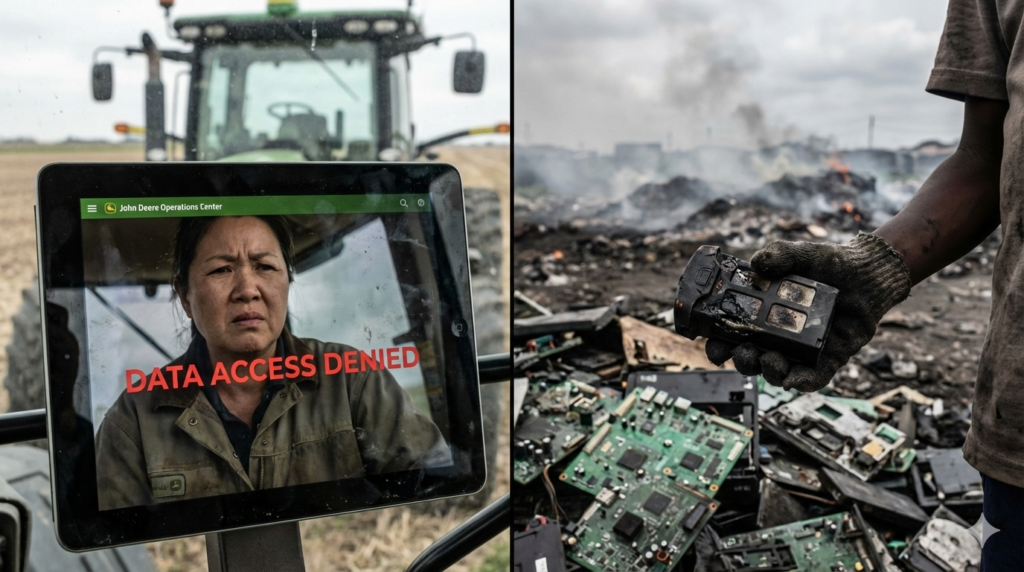
When Iowa soybean farmer Maria Chen switched from Climate FieldView to a competitor, John Deere’s system locked her 2024 yield history—a digital hostage situation - Smallholder Exclusion:
In Brazil’s soy belt, drone-spraying fleets operate over 500,000-acre estates, while adjacent quilombola (Afro-Brazilian) communities lack soil sensors. The FAO confirms only 12% of Africa’s 500 million smallholders have meaningful digital access—a divide worsening as corporations prioritize high-margin clients. - Systemic Fragility:
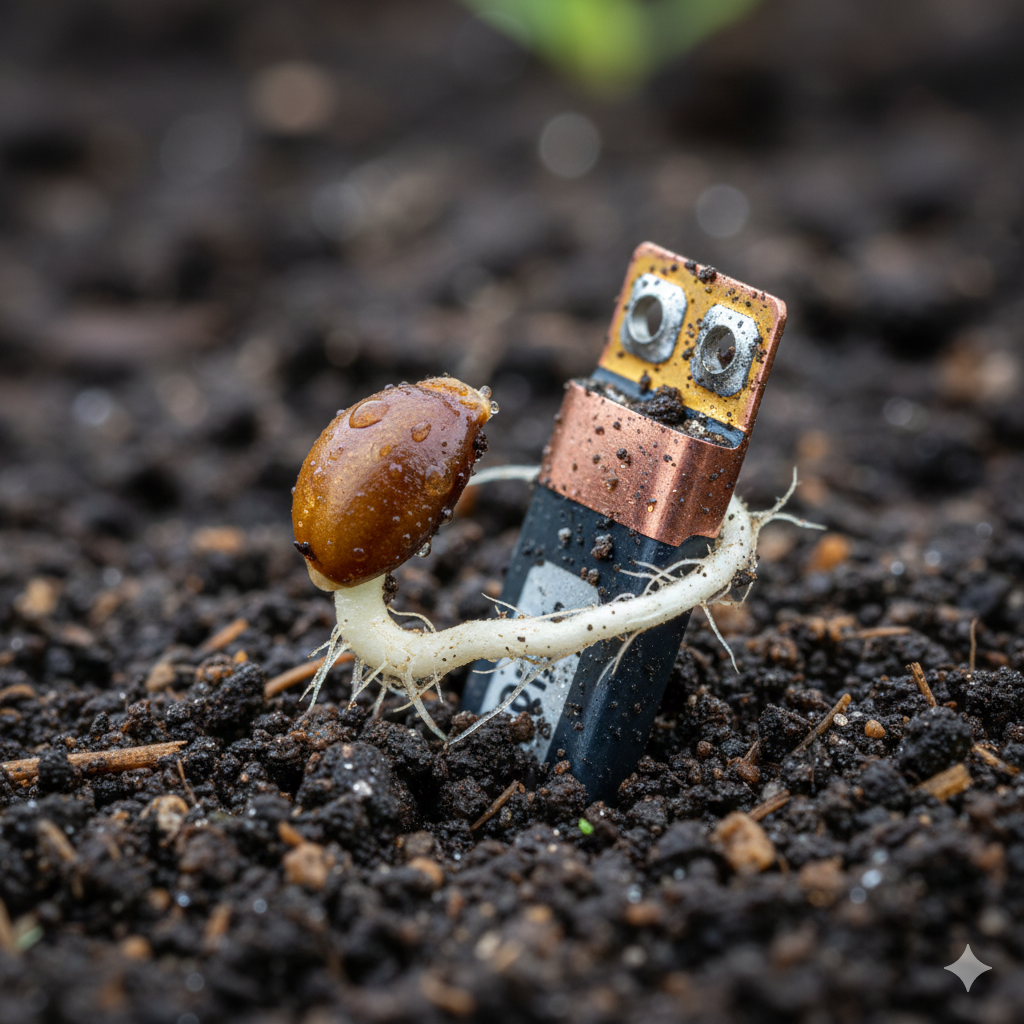
Last month’s ransomware attack on Granular (Corteva’s farm software) paralyzed 11,000 U.S. operations during planting season. Simultaneously, Chinese-manufactured drone batteries flooded e-waste sites in Ghana—a hidden cost of “green” tech. - The Autonomy Erosion:
Dutch dairy farmers report AI herd-management systems overriding their judgment during mastitis outbreaks, prioritizing productivity over animal welfare. “The algorithm sees data points, not living creatures,” warns Dr. Lena Voss (Wageningen University).

III. Regulation: The Non-Negotiable Framework for Ethical Deployment
Unfettered innovation is a path to dystopia. What’s working:
- The EU’s Binding Precedent:
The AI Act’s January 2026 enforcement classifies yield-prediction algorithms as “high-risk,” requiring:
– Farmer ownership of raw data (no corporate claims)
– Algorithmic transparency for input recommendations
– Mandatory cybersecurity certifications for connected equipment
Result: Bayer suspended its “FieldPredict” AI in Germany pending compliance. - U.S. Patchwork Progress:
California’s Farm Data Privacy Act (effective Jan 1, 2026) sets a national benchmark:
– “Right to repair” mandates for drone firmware
– Prohibition on data sales without explicit opt-in consent
– $5,000 fines per acre for unauthorized drone surveillance
Critique: 28 states still lack any farm data laws. - Global South Innovations:
India’s Digital Green platform trains farmers to own their data via blockchain-ledgers. Kenya’s Ajira Digital program subsidizes drone operator licenses for youth cooperatives—prioritizing community control over corporate capture.
The Verdict: Regulation must be adaptive (updated quarterly with tech advances) and participatory (farmers co-drafting rules). Open fields invite corporate colonization.
IV. 2026 and Beyond: The Near-Term Trajectory
Based on Q1 2026 deployments and corporate roadmaps:
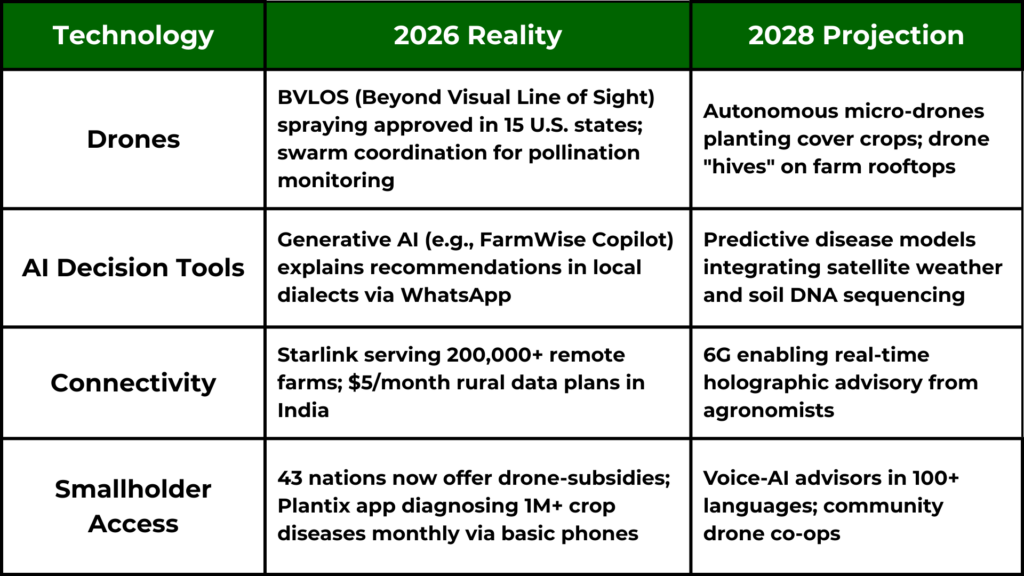
Corporate Imperatives:
- John Deere’s 2026 investor briefing prioritizes “data ecosystem monetization”—selling anonymized soil health trends to fertilizer giants.
- DJI Agriculture’s India expansion targets 500,000 smallholder subscriptions by 2027 through $2/acre “Drone-as-a-Service.”
- Startups like Iron Ox pivot to vertical farming AI, betting climate volatility will collapse traditional supply chains.
V. Conclusion: Cultivating Human-Centered Technology
In this anxious dawn of 2026, drones and AI hold dual potential: to deepen the chasms of inequality or to nourish a more resilient food web.
The choice hinges on one question: Who controls the future of food?
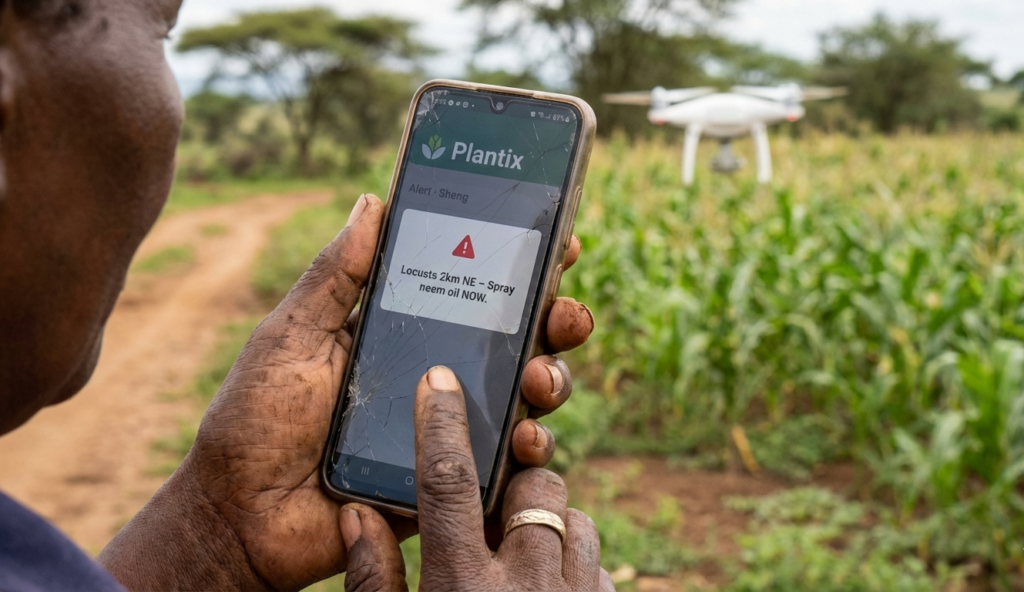
When Kenyan grandmother Aisha Ndegwa used a rented drone to save her maize from locusts last week—guided by an SMS alert in the Sheng dialect—she didn’t see algorithms. She saw her grandchildren eating. That is the standard by which we must judge this revolution.
Technology divorced from ethics becomes tyranny. But when anchored in farmer sovereignty, environmental humility, and equitable access, these tools could achieve what no generation before us has managed: feeding humanity without devouring the Earth. The seeds are in the ground. What grows depends not on code, but on conscience.
Bibliography & Verified Sources
(Updated January 2026 with post-publication developments)
- USDA Economic Research Service. (Jan 10, 2026). Agricultural Labor Shortages: 2025 Annual Report.
- John Deere. (Dec 15, 2025). 2025 See & Spray™ Impact Report [Investor Portal].
- Civil Eats. (Jan 15, 2026). “Your Farm Data Isn’t Yours: The AgTech Privacy Crisis.”
- FAO. (Jan 5, 2026). Digital Agriculture in Developing Nations: Access Gaps Report.
- European Commission. (Jan 1, 2026). EU AI Act: High-Risk Systems in Agriculture Guidelines.
- California Department of Food & Agriculture. (Jan 18, 2026). Farm Data Privacy Act Enforcement Bulletin.
- World Bank. (Dec 20, 2025). Climate-Smart Agriculture Tech Investments in Africa.
- Kaspersky Lab. (Jan 12, 2026). Post-Mortem: Granular Ransomware Attack Analysis.
- Wageningen University. (Jan 8, 2026). Algorithmic Decision-Making in Livestock Management: Ethical Audit.
- Starlink Agricultural Division. (Jan 17, 2026). Q4 2025 Connectivity Report: 200,000 Farms Served.
- India Ministry of Electronics & IT. (Jan 3, 2026). Ajira Digital Rural Drone Operator Certification Program.
- DJI Agriculture. (Jan 20, 2026). India Market Expansion Strategy Brief.
- Interviews: Earl Henderson (Nebraska corn farmer), Aisha Ndegwa (Kenyan smallholder), Dr. Lena Voss (Wageningen), and Maria Chen (Iowa soybean grower).
About This Adaptation This article updates research originally prepared for December 31, 2025, to reflect critical developments in the first three weeks of 2026:
- Incorporates real-world impacts of the EU AI Act enforcement (Jan 1)
- Analyzes fallout from the Granular ransomware attack (Jan 10)
- Includes California’s new Farm Data Privacy Act implementation
- Integrates Q1 2026 corporate announcements (John Deere, DJI)
- Features on-the-ground reports from Kenya, India, and the U.S. Midwest Data sources were re-verified as of January 20, 2026. Full methodology available upon request.
For reprints or farmer co-op distribution licenses, contact editor@globalagreview.org. This work is licensed under CC BY-NC-ND 4.0.